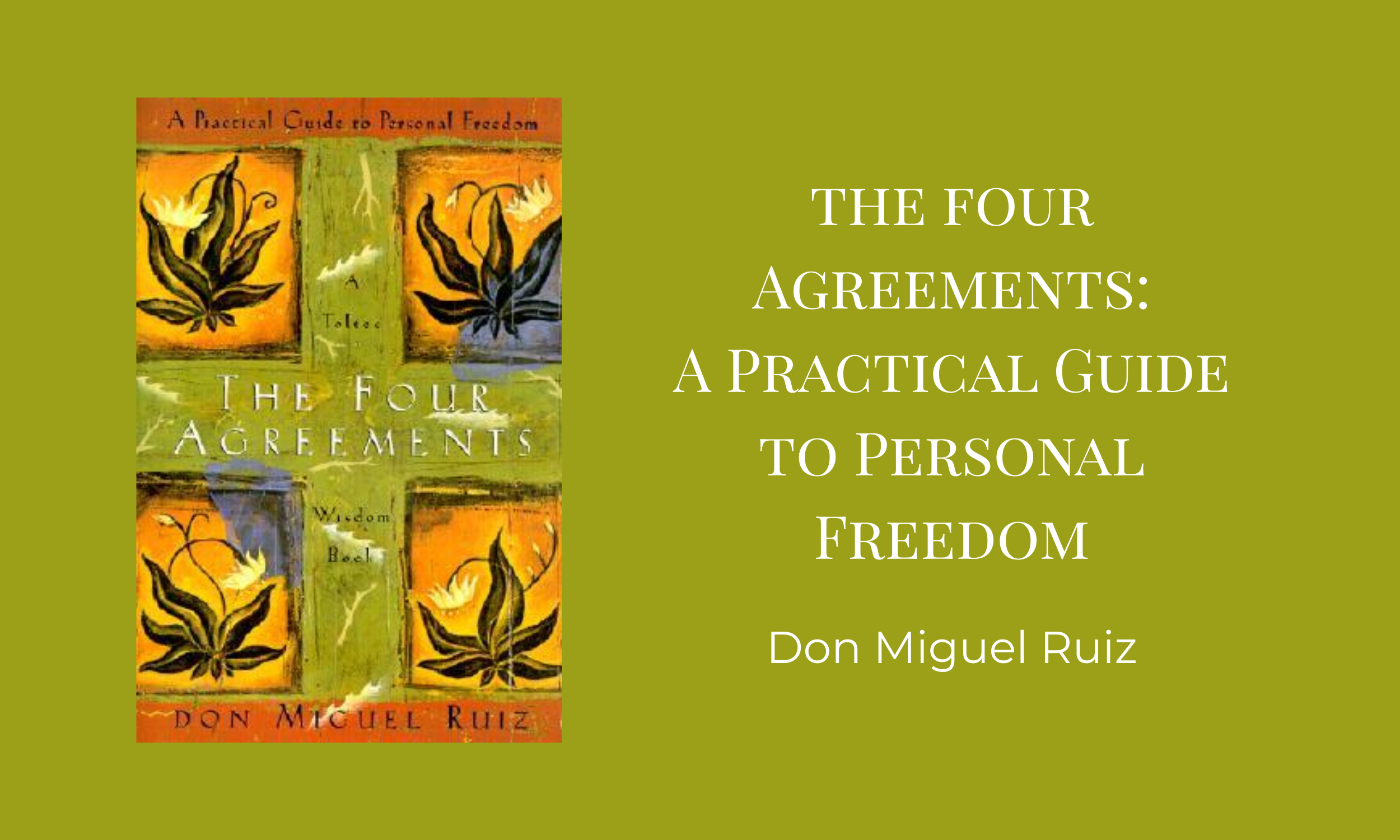
Book: The Four Agreements
I was gifted this book by a mentor, but it’s been on my list for years. I’m really glad my mentor sent it to me, because having it physically in my hands, I prioritized reading it now instead of later. I read Miguel Ruiz’s book in mere days. In ways, it reminded me of The Art of War or Meditations by Marcus Aurelius. But a masterspace in its own right. In fact, when I shared that I read this book online, I got many responses saying that it was among the most profound and influential books my friends have read. That’s a pretty big statement, and I heard it multiple times. So, while I highly recommend you buy the book and read it yourself, I’ll give you my key takeaways in case you don’t have the time yet.
Table of Contents
1.The Concept & Catalyst | 2.The Synthesis | 3.The Implementation | 4.The Link
1. The Concept & Catalyst
Before it was sent to me, I chose this book on my TBR list because, as the subheading of the title says, I want personal freedom. The specific problem it promises to solve is sharing ancient Toltec wisdom on how to transform your life and erase limiting beliefs. I found this to be conceptually very true because the wisdom shared is incredibly powerful. But I said conceptually, because merely reading the words won’t change your life. You must put them into action for there to be change. I’ve been practicing the four agreements, unknowingly, for years, and I can say without doubt that when I live in accordance with them, my life changes for the better.
2. The Synthesis
From my perspective, the core lesson(s) can be summarized in the following quote.
The belief system is like a Book of Law that rules in our mind. Without question, whatever is in that Book of Law, is our truth. We base all of our judgements according to the Book of Law, even if these judgments go against our own inner nature… Even if the Book of Law is wrong, it makes you feel safe. That is why we need a great deal of courage to challenge our own beliefs. Because even if we know we didn’t choose all these beliefs, it is also true that we agreed to all of them. The agreement is so strong that even if we understand the concept of it not being true, we feel the blame, the guilt, and the shame that occur if we go against these rules.
This relates not only to life, but also to solo travel. In both instances, we are shaped by the “truths” we repeat to ourselves. Whether we believe them to be true to us or not, if they’re an agreement we’ve made with ourselves, then we will stick to it like law. In the same way, if we tell ourselves something is too scary, too unknown, too risky (like solo travel), and we make an agreement with ourselves that’s true, we must overcome many mental hurdles to flip the script.
Otherwise, the more “obvious” lessons can be derived from some of the section titles:
The First Agreement — Be Impeccable with Your Word
The Second Agreement — Don’t Take Anything Personally
The Third Agreement — Don’t Make Assumptions
The Fourth Agreement — Always Do Your Best
The Toltec Path to Freedom — Breaking Old Agreements
When we are aware of our agreements, we can make changes to them and rewrite our story. “Awareness is always the first step because if you are not aware, there is nothing you can change.” It will take a great deal of effort to change those agreements, but transformation can occur. We can be the authors of our own stories.
3. The Implementation
If I were to give you a cheat sheet so that you never had to open the book, aside from The Synthesis, I would implore you to read these quotes from the book —
“The limit of your self-abuse is exactly the limit that you will tolerate from someone else.”
“If you want to live a life of joy and fulfillment, you have to find the courage to break those agreements that are fear-based and claim your personal power. The agreements that come from fear require us to expend a lot of energy, but the agreements that come from love help us to conserve energy and even gain extra energy.”
“Regardless of what language you speak, your intent manifests through the word… Your word is pure magic, and misuse of your word is black magic.”
“Being impeccable is not going against yourself. When you are impeccable, you take responsibility for your actions, but you do not judge or blame yourself.”
“Your opinion is nothing but your point of view. It is not necessarily true. Your opinion comes from your beliefs, your own ego, and your own dream.”
“When we take something personally, we make the assumption that they know what is in our world, and we try to impose our world on their world.”
“We make all sorts of assumptions because we don’t have the courage to ask questions.”
“But keep in mind that your best is never going to be the same from one moment to the next. Everything is alive and changing all the time, so your best will sometimes be high quality, and other times it will not be as good.”
“When you do your best you learn to accept yourself. But you have to be aware and learn from your mistakes. Learning from your mistakes means you practice, look honestly at the results, and keep practicing. This increases your awareness.”
“Action is about living fully. Inaction is the way that we deny life… Expressing what you are is taking action.”
“The freedom we are looking for is the freedom to be ourselves, to express ourselves.”
“Forgiveness is the only way to heal.”
4. The Link
I love books like this because the message is so clear and easily understandable. The greater challenge is with implementation. Even though this isn’t specifically about solo travel, the conclusions can be transferred to all aspects of life. While I love reading (find my updated list of books read here), I wish I had a blueprint before, and during, my solo travel journey. That’s why I’m writing a book just like that. Based on my personal experiences, journal entries, life lessons, epiphanies, and so much more. I’m creating for you what I wish I had when I started. Thank you for being the inspiration.