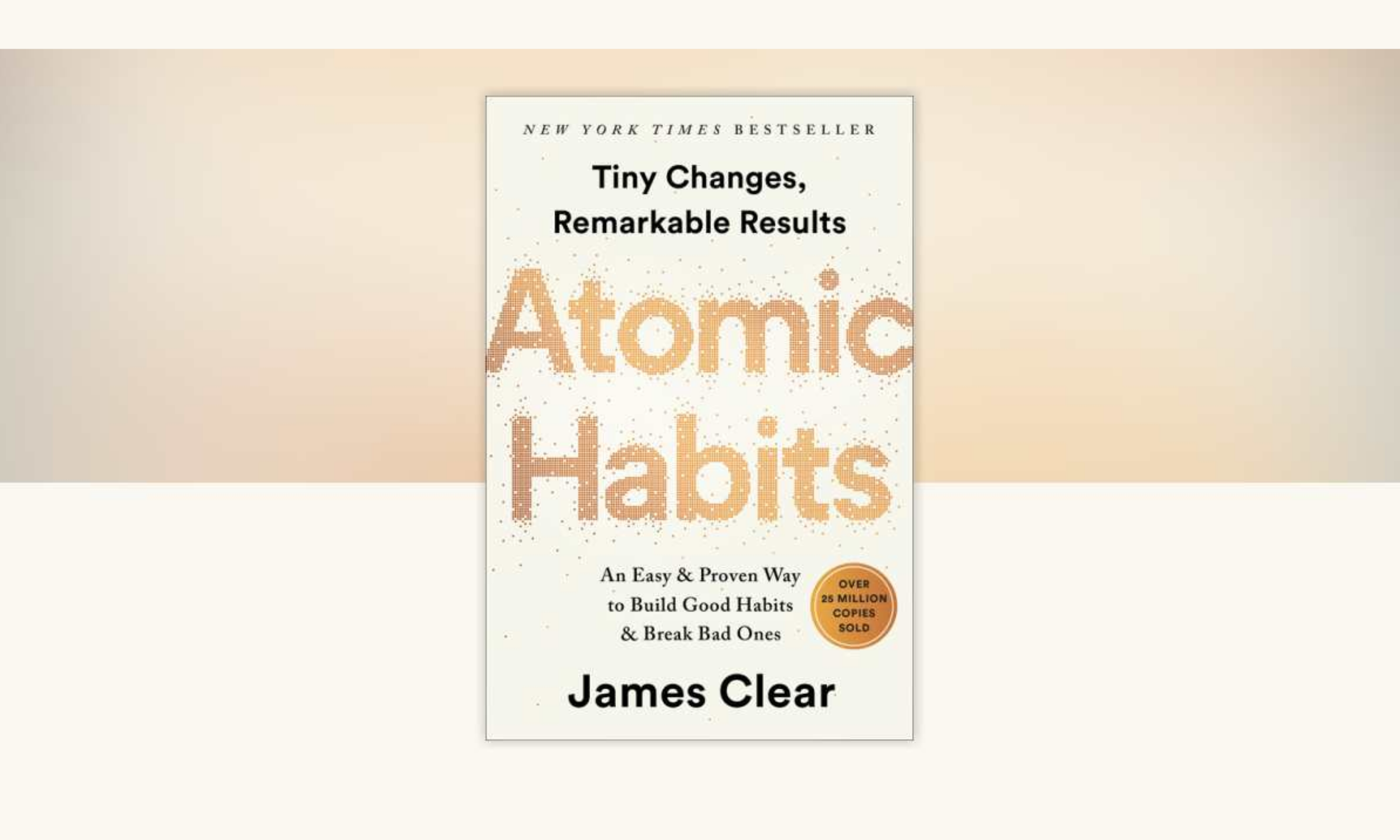
Book: Atomic Habits
What better book to start out the first of the year than one on building good habits… or maybe a bit cliché. Regardless, I finished James Clear’s book in five days. This book has been on my TBR (To Be Read) list for years, and I finally picked it up at the airport at the end of 2025. On the one hand, I wish I had read it years ago — on the other, it was incredibly validating to see I already use many of the hacks that Clear suggests. I would absolutely, hands-down recommend this book to literally anyone. In fact, I even talked about it enough that my dad bought a copy just yesterday. That said, I’m going to share with you my top insights so that if you don’t quite have the time yet, you can still benefit from this book.
Table of Contents
1.The Concept & Catalyst | 2.The Synthesis | 3.The Implementation | 4.The Link
1. The Concept & Catalyst
I chose this book because just like you, I am an incredibly lazy person. No matter how much I value discipline, mark up my calendar with reminders, or set automations and alarms on my phone, I can’t escape the fact that I am just pure lazy. In fact, that’s an absolute that Clear dives into in the book. Humans are innately wired to do the easiest thing possible. Atomic Habits promises to solve the specific problem of building good habits and breaking bad ones. I found this book to truthfully deliver on that claim, because the insights, research, and real-life examples provided are not only relatable, but implementable.
2. The Synthesis
From my perspective, the core lesson can be summarized by the following quote:
The concept of identity-based habits is our first introduction to another key theme in this book: feedback loops. Your habits shape your identity, and your identity shapes your habits… The focus should always be on becoming that type of person, not getting a particular outcome.
The stage of my life that I’m in right now, I hugely relate to the concept of identity shaping. An example of this that is adapted from the book is as follows — You can say that your goal is to workout 3 days a week. The habit would be going to the gym 3 days a week and using the machines. But the real key is showing up at the gym 3 days a week. Every time you step into the gym, you are becoming the type of person who works out. That reframes your identity in your mind, whether consciously or not. And once you start believing, “I’m the type of person who shows up and goes to the gym 3 days a week,” the easier and faster you see the results of the habit you build (i.e., working out 3 days a week). Or as Clear puts it, “Every action you take is a vote for the type of person you wish to become.”
Otherwise, the more “obvious” lessons can be derived from some of the section titles:
The 1st Law — Make It Obvious
I will [behavior] at [time] in [location].
After I [current habit], I will [new habit].
The 2nd Law — Make It Attractive
After I [current habit], I will [habit I need].
After I [habit I need], I will [habit I want].
The 3rd Law — Make It Easy
The 4th Law — Make It Satisfying
After I [current habit], I will [track my habit].
These relate to any and all habits/goals/dreams/actions you want to do — or stop doing, by reversing the Laws (e.g., instead of making it obvious, make it invisible; instead of attractive, make it unattractive; instead of easy, make it difficult; instead of satisfying, make it unsatisfying). If the habits that you want to stick to align with these 4 Laws, the likelihood of achieving significantly goes up.
3. The Implementation
If I were to give you a cheat sheet so that you never had to open the book, aside from The Synthesis, I would say —
Create the environment (physical, but also mental) that gives you cues of good habits that make them obvious and visible. This might include a rather significant change of location to one where the culture has the habits you desire. You can also “prep” your environment for your next good habit so it’s easy.
Bundle your habits; something you want to do with something you need to do, something you want to do with something you always do.
Create rituals; doing something you enjoy immediately before a difficult habit to hype yourself up for it and make it attractive.
Reduce friction; make sure the distance between you and your habits has the fewest steps possible to make it easy.
Use the two-minute rule; to start good habits, they shouldn’t take more than two minutes to do.
Automate whenever possible; technology is near limitless these days — use it to your advantage.
Reinforce the behavior; reward yourself when you complete a habit to make it satisfying.
Track your habits; studies show tracking makes you more likely to do it.
Never miss twice; it’s okay if you miss a day, but never miss two times in a row.
Reframe your mindset; keep the ultimate goal to become the type of person who [enter the habit], not the habit itself. Then, they stick for a lifetime.
4. The Link
I love books like this because you get infused with so much juicy knowledge in a mere <300 pages with clear action steps. Even though this isn’t specifically about confidence or community or solo travel, the conclusions can be transferred to all aspects of life. While I love reading (find my updated list of books read here), I wish I had a blueprint before, and during, my solo travel journey. That’s why I’m writing a book just like that. Based on my personal experiences, journal entries, life lessons, epiphanies, and so much more. I’m creating for you what I wish I had when I started. Thank you for being the inspiration.